
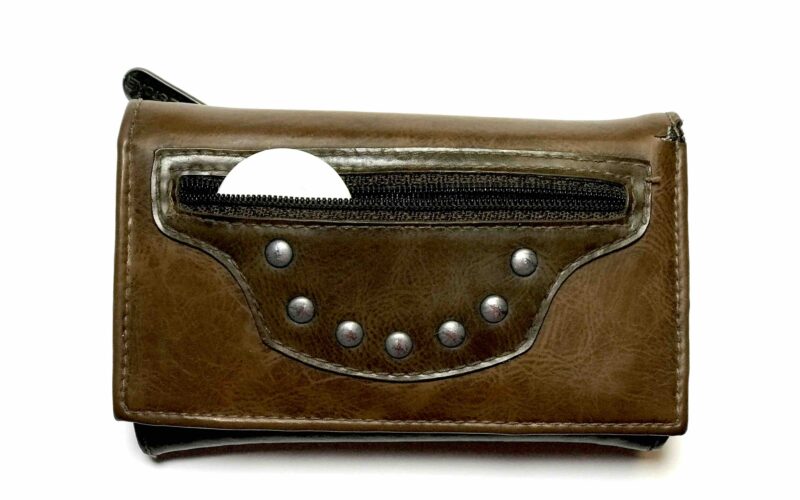
My daughter asked me to help her find her lost wallet. She knew it was somewhere across the city, in the East End. She’d hidden a locator tag inside. She lost it while thrifting at Kensington Market but had no idea how it ended up all the way in Scarborough. We were about to find out.
I was worried. We had no idea who had picked it up. Had they taken it from her? Would they just hand it over if we showed up at their door? And if they refused, then what? I tried to push those thoughts aside and just talked with my daughter during the drive. It took about an hour.
When we arrived, the locator brought us to a three-storey apartment complex. It was precise. It led us straight to a small blue Honda parked in the back lot. Nothing special about it, except for a gold ball and a red ornament hanging from the rearview mirror – looked like some kind of Asian charm.
So, now what? We figured we’d try to find the owner through the building. We went inside, buzzed the “rental office,” and got let in. But the office was closed. I asked a couple of people coming in from the parking lot if they recognized the car. No luck. But people were starting to come and go.
Then we saw them. An older man in the driver’s seat. A younger woman in a hijab getting into the back. A family, I thought—and felt a bit relieved. My daughter and I walked up and asked the driver if he had found a wallet in Kensington Market. We explained that a locator showed it was in his car.
The man looked at us and I could see confusion and a bit of fear in his face. Does he think we are about to rob him? I thought for a second. Then he said, in a thick accent, defensively, “I knocked on your door many times to give you your wallet, but you didn’t answer.” My daughter blinked. “But… I don’t live in this building.” It took her a moment, but then it clicked. He was her Uber driver. Still uneasy, he asked how we found him. He kept glancing at us, unsure. We explained about the tracking device.
He reached over, pulled out my daughter’s wallet, and handed it to her. Just like that.
I offered him some cash to thank him for holding onto it. He hesitated. He didn’t want to take it. I insisted. “It’s for gas,” I said. “It’s expensive these days.” Eventually, he accepted. We got back in the car, both of us relieved.
I called my wife and told her what happened. I mentioned that the whole thing went smoothly but that the man seemed scared. I figured maybe he thought we were delinquents. She laughed. “It’s not that,” she said. “He’s probably scared because he’s an immigrant.” I didn’t get it. She said she’d explain when we got home. That night, we had a small family gathering, my father-in-law and a couple of close family friends.
Everyone at the table, except me, was an immigrant. And they all got it. I didn’t. “He thought you were authorities,” my father-in-law said. “Or that you might bring them.” They explained that for many immigrants—especially those still sorting out their status—there’s a constant, underlying fear. That something small could go wrong. That a misunderstanding, an accusation of something improper, even bad timing could affect their paperwork. Their ability to stay in Canada. Everything they’ve built could disappear.
They told me that people who don’t arrive with secure status often live with that uncertainty every day. That the stakes are always higher than they seem. I sat there quietly, taking it in. I’d never really thought about it like that. Then my wife said, “You don’t understand because you’re not an immigrant. You’re the child of immigrants. That’s different.”
She’s right. My parents are immigrants and I’ve grown up around immigrants my whole life. But I’d never felt this kind of fear in Toronto. Like he did.